Talk First Family® | Family Activities
Suggested Age: 5–12 | Time: 5–10 minutes
Family Game: Who Can Help? Challenge | Part of Our Family Safety Plan — Phase 1
Everybody needs someone they can talk to! Sometimes children have questions, worries, or experiences they aren't sure how to discuss.
In this family game, your child builds a Trusted Helper Team—grown-ups they can turn to for support. Then you play a few “Who Can Help?” challenges and practice asking for help. The goal is connection, confidence, and conversation—not perfect answers. Adults remain responsible for protecting children.
One piece of paper, crayons, markers or pencils, and six small pieces of paper for the Challenge Cards. No printer is required.
“Every good team has people who help one another. Let's build your Trusted Helper Team and play a few rounds of Who Can Help?”
Draw three large circles on the paper. Invite your child to write a name or draw a picture of an adult they could approach for help in each circle. Your child may choose more than three.
Helpers might include a parent or caregiver, grandparent, relative, teacher, school counselor, or another appropriate adult. When possible, include a helper outside the immediate household.
Ask: “Which grown-ups make you feel heard and supported?” How do we recognize a trustworthy helper? A trustworthy helper listens, takes your concerns seriously, respects your boundaries, and helps you get support when you need it. If someone doesn't listen or help, you can ask another trusted adult. Parents should help confirm that the chosen adults are appropriate, accessible, and willing to help. Parent reminder: Choose helpers based on dependable behavior, not familiarity alone. When practical, check privately that each adult is willing and able to help your child. Keep the list accessible to your child but protected from unnecessary public sharing.
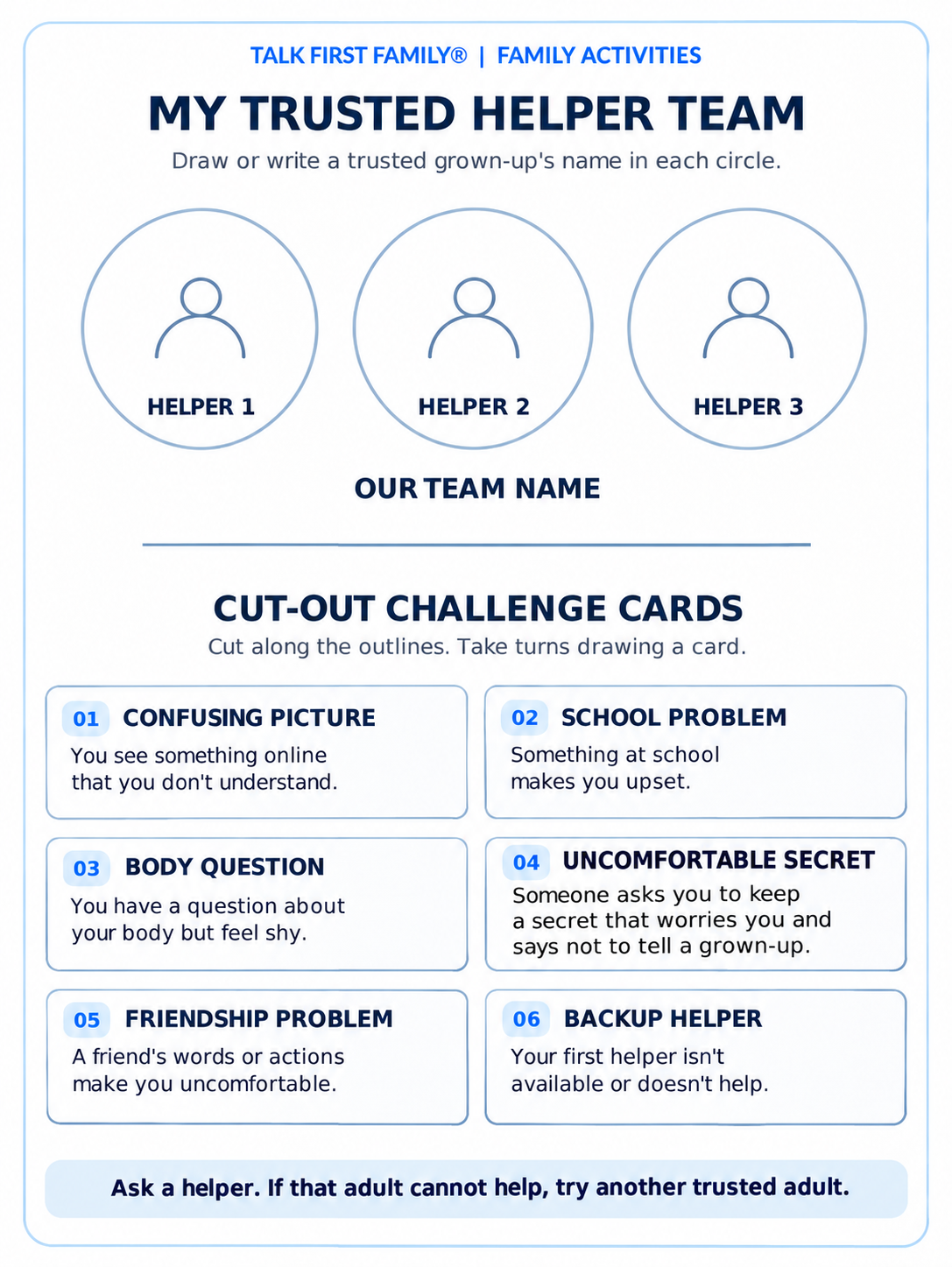
Write these six challenges on small cards, shuffle them, and draw one at a time. Read the imaginary situation aloud. Your child picks a team member who might help and practices asking.
Card 1 — Confusing Picture: You see something online that you don't understand.
Card 2 — School Problem: Something happens at school that makes you upset.
Card 3 — Body Question: You have a question about your body but feel embarrassed.
Card 4 — Uncomfortable Secret: Someone asks you to keep a secret that worries you and says not to tell a grown-up. Who could help?
Card 5 — Friendship Problem: A friend says or does something that makes you uncomfortable.
Card 6 — Backup Helper: Your first helper is unavailable or doesn't help.
There are no points or winners. Use imaginary examples; children never need to share private experiences to play.
Choose a helper and take turns pretending to ask for help. Children can try:
Model a helpful adult response: “I'm glad you told me. I'm listening. Let's figure out how I can help.”
Ask: “What if your first helper isn't available? What if you tell an adult and they don't listen or help?” Have your child choose another helper and practice again.
Explain that children can keep telling trusted adults until someone helps. You can ask for help even if someone told you not to tell, or if you're worried you made a mistake. Adults are responsible for taking protective action.
Let your child pick a fun team name, such as The Helping Hands or The Super Listeners. Put the drawing somewhere accessible, while keeping names and contact information private.
Child choice: Your child can draw, talk, write, or pass on a question. This is not a test.
If something your child shares during an ordinary conversation catches your attention:
Pause ✶ — “Something caught your attention. Notice it. Do nothing yet.”
Then, if helpful, use:
👉 Know What to Do — “What's our next step?”
You might also ask: “Who could you talk to first?” “What could you say?” or “Who else could you tell if your first helper couldn't help?”
One question may be enough.
Important: If a child describes abuse, threats, exploitation or danger, stop the game and prioritize protection and appropriate professional, reporting, or emergency assistance. Do not delay necessary safety action to complete TALK.
Have a question about trusted helpers, something your child shared, or how to continue the conversation?
Ask Granny. Select the blue Ask Granny button in the bottom-right corner of this page. Granny can help parents and caregivers find age-appropriate words and explore approved Talk First Family® resources. Granny is not designed for children's independent use.
External Educational Resource
University of Rochester — Preventing Child Sexual Abuse
Parent education about building trusted relationships, healthy development, recognizing concerns, and safeguarding children.
Approved for display as an external educational link by Talk First Family®. This does not imply University of Rochester endorsement of Talk First Family®.